Published by: Faculty of Materials Edited by: Zhou Tongjiang
WUST News — The State Key Laboratory of Advanced Refractories of Wuhan University of Science and Technology (WUST) published a research paper titled Engineering micro-nano structures of SiOC via boron doping-induced self-assembly for superior cyclic stability of lithium-ion batteries in the top-tier materials journal eScience (2025 IF = 36.6, ranking 3rd among 438 materials science journals).
The paper introduces an innovative "boron doping-induced interconnected self-assembly" strategy and successfully prepares three-dimensional interconnected SiOCB hollow porous microspheres with their electrochemical performance as anode materials for lithium-ion batteries systematically investigated. Li Kezhuo and Yuan Gaoqian, 2024 Ph.D. graduates from the Faculty of Materials, are the paper’s first authors while Professors Lei Wen and Zhang Haijun from the State Key Laboratory of Advanced Refractories are the corresponding authors.
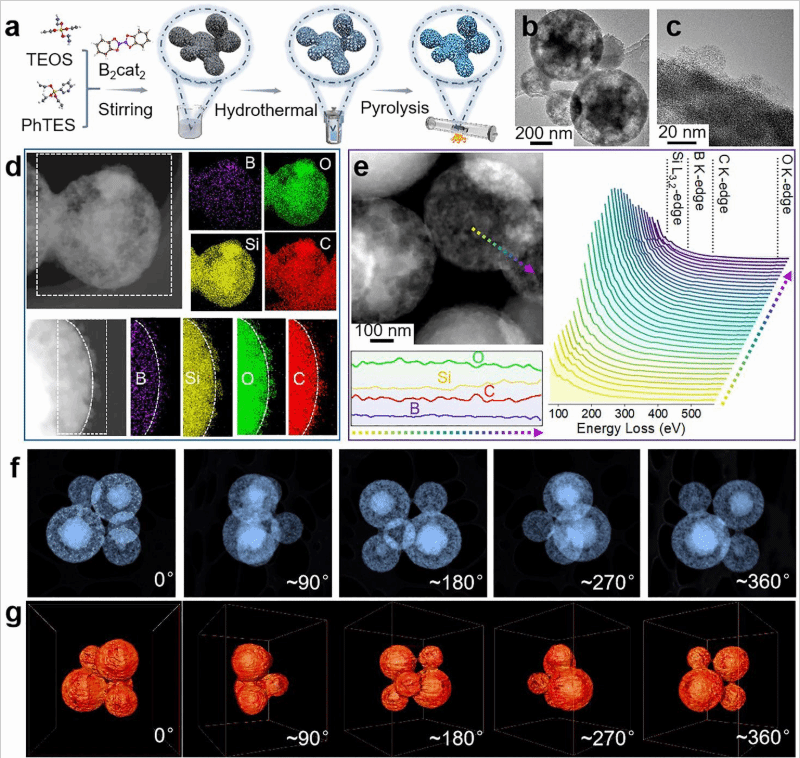
Figure 1: Preparation Process and Microstructure Characterization of Three-dimensional Interconnected Hollow Porous SiOCB Microspheres
Using the polymer precursor method, the team prepared three-dimensional interconnected spherical hollow porous SiOCB powders with neck connections (Figure 1). STEM-HAADF 3D reconstruction and EDS/EELS analyses confirm the presence of a 3D interconnected microstructure, with Si, O, C, and B elements uniformly distributed at the necks and surfaces of the microspheres. The particle size and pore structure of the powder can be precisely controlled, with bis(catecholato)diboron (B₂cat₂) playing a key role in forming the interconnected architecture.
The study revealed that B(OR)ₙ hydrolyzed from B₂cat₂ induces self-assembly of B–O–Si polymers during hydrothermal synthesis, forming a porous skeleton that remains stable after heat treatment. This creates nanochannels and a 3D "highway" for efficient electron/ion transport while maintaining electrode density, facilitating rapid lithium storage.
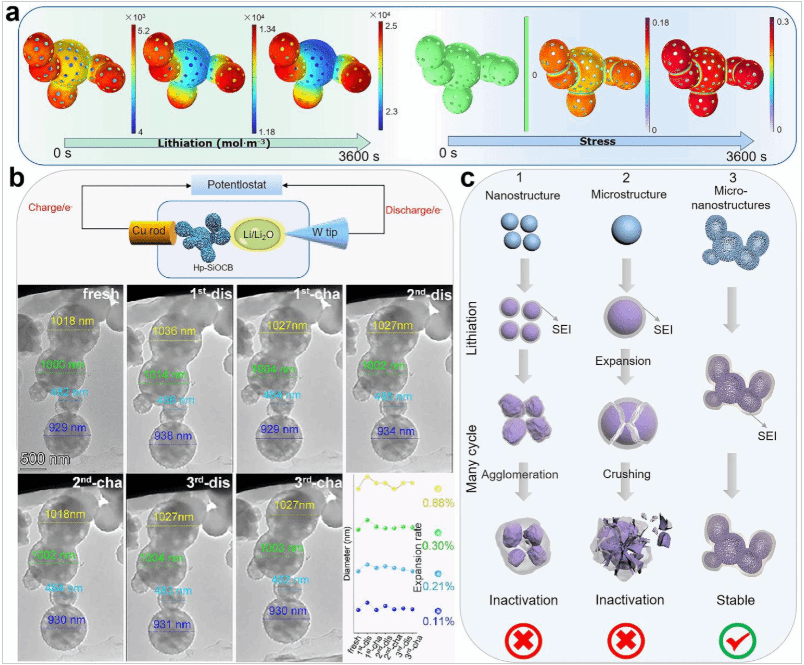
Figure 2: Stress Dispersion and Volume Expansion Suppression Mechanism of Three-dimensional Interconnected Hollow Porous SiOCB Microspheres
Further results show that the prepared Hp–SiOCB–20 sample exhibits low charge transfer resistance (~80 Ω) and high Li⁺ diffusion coefficient (10⁻⁹–10⁻¹¹ cm⟡·s⁻¹), outperforming currently reported SiOC-based anode materials in rate capability and cycling stability. COMSOL finite element simulations and in-situ TEM characterization indicate that during lithiation/delithiation, local strain in the 3D interconnected hollow porous SiOCB microspheres is reduced from ~3 nm to ~0.3 nm, effectively dispersing stress and suppressing electrode expansion.
After three charge–discharge cycles, the hollow porous SiOCB microspheres show only ~0.38% average expansion with no crystalline phase precipitation, and the 3D interconnected structure remains intact after 300 cycles. The electrode delivers a reversible specific capacity of 801 mAh·g⁻¹ at 0.1 A·g⁻¹ and retains 99% capacity after 300 cycles at 1 A·g⁻¹.
A full cell assembled with Hp–SiOCB–20 anode and NCM811 cathode exhibited an initial charge capacity of ~183 mAh·g⁻¹, with less than 5% capacity decay in subsequent cycles and ~90% Coulombic efficiency, demonstrating strong practical potential for Li-ion battery applications.
In summary, the 3D interconnected hollow porous SiOCB anode material—constructed via the novel "boron doping-induced self-assembly" strategy—achieves synergistic "low impedance, fast diffusion, high capacity, long life" performance in lithium-ion batteries. It significantly suppresses volume expansion during cycling, while boron active sites and a carbon-rich environment enhance Li⁺ adsorption and charge transfer. This work deepens the understanding of Li storage mechanisms in SiOC-based materials and provides key theoretical support for their use in high-performance energy storage devices. (Faculty of Materials)